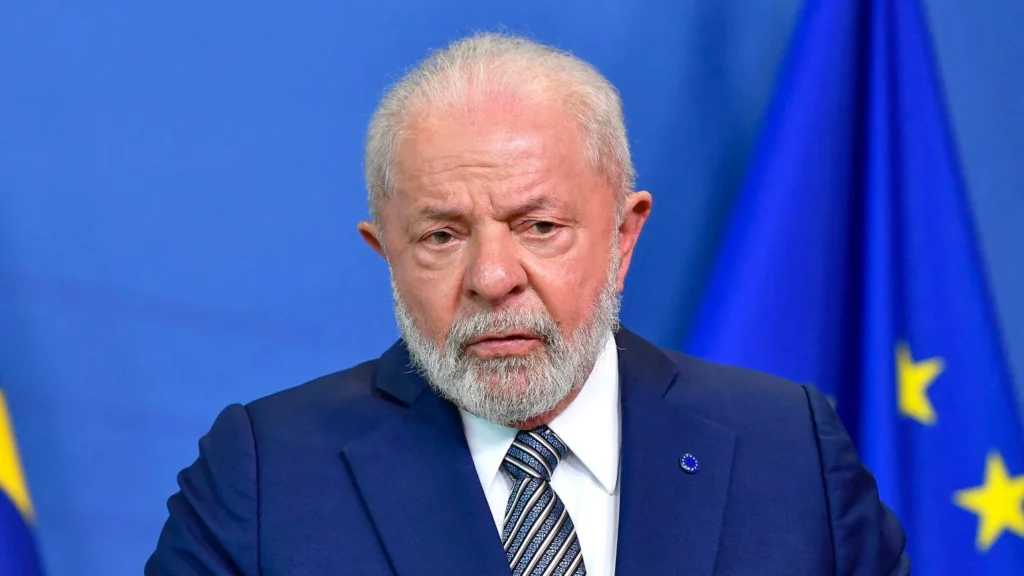

Brazilian President Luiz Inácio Lula da Silva has challenged United States President Donald Trump over his approach to international relations, arguing that Washington has no right to impose its will on other sovereign nations.
In an exclusive interview with CNN’s Christiane Amanpour ahead of the United Nations General Assembly (UNGA) in New York, Lula said countries should be free to protect their national interests, determine their own policies and pursue diplomatic negotiations without external pressure.
The Brazilian leader argued that while Trump had been elected to govern the United States, his mandate did not extend to directing the affairs of other countries.
“President Trump was elected to be the US president. He has the right to govern the US, but he doesn’t have the right to govern other countries,” Lula said.
He added that the United States should approach international relations through negotiation rather than attempting to impose its preferences on other nations.
“He doesn’t have the right to impose his will. He has to have the willingness to negotiate,” the Brazilian president stated.
Lula Defends Brazil’s Sovereignty and National Interests
Lula emphasised that every country has the right to make decisions concerning its own affairs, warning against the imposition of American rules on other nations.
“We just want to say that every country has their own sovereignty. They take care of their own interests and the US cannot impose their rules over the others,” he said.
His comments reflect ongoing tensions surrounding Brazil–US relations, particularly trade policy, diplomatic pressure and Washington’s role in Latin America.
Brazil Rejects US Tariffs, Seeks Alternative Trading Partners
The Brazilian president also criticised tariffs imposed by the Trump administration on Brazilian imports, describing the measures as unjustified and accusing Washington of relying on false claims.
According to reporting on the CNN interview, the United States imposed tariffs on Brazilian goods, while Washington cited concerns related to trade practices, digital commerce, intellectual property and other policy issues. Lula disputed the rationale behind the measures and said Brazil was working to strengthen commercial relationships with other countries.
The president said Brazil’s exports to the United States had declined by 9%, while imports from the US fell by 8.5%. He also pointed to expanding trade relations with countries including China, Japan, Germany and the European Union.
Rather than focusing solely on the economic impact of the tariffs, Lula said Brazil would seek new commercial opportunities and strengthen its partnerships.
“So I’m not going to just try to cry out about the milk that was spilled on the floor. I’m going to seek other partners to try to buy and sell,” he said.
Lula maintained that Brazil was still open to negotiations with the United States and would consider reciprocal measures if diplomatic discussions failed.
“I don’t want to go to a tariff war with the US and neither with any other country,” he said.
Reuters reported on September 21 that Lula intended to continue trade negotiations with Washington and would refrain from invoking Brazil’s reciprocity law while talks remained underway.
Lula Raises Concerns About Possible US Interference in Brazil’s Elections
During the interview, Lula also expressed concern about possible foreign interference in Brazil’s electoral process, including the use of artificial intelligence.
The Brazilian president referred to what he described as indications involving potential interference and mentioned the relationship between US Secretary of State Marco Rubio and members of the Bolsonaro family.
However, Lula acknowledged that his concerns were not supported by concrete evidence at the time.
“But for the meanwhile, we just have suspicion. There’s nothing concrete,” he said.
His comments came as Brazil prepared for its 2026 presidential election, amid political tensions involving the Brazilian government and figures associated with the Bolsonaro family.
Lula has separately called for foreign governments to respect Brazil’s electoral sovereignty and avoid actions that could influence the country’s democratic process.
Lula Criticises US Role in Venezuela
Lula also criticised Washington’s involvement in Venezuela, arguing that US actions had created the impression that the United States was exercising excessive control over the South American country.
His comments followed the US military operation in January that resulted in the capture of former Venezuelan President Nicolás Maduro and the subsequent emergence of Delcy Rodríguez as interim president.
The Brazilian leader questioned the extent of Venezuela’s independence under the new political arrangement, particularly in relation to agreements involving the United States.
“The US conveys the idea that they’re governing Venezuela,” Lula said.
“Every document that we read, the agreements, it looks like the US is the big boss of Venezuela, the sovereignty of the country has ended.”
Lula argued that Venezuela’s political future should be determined by its own citizens through a national election.
“If I was Delcy, the president, I would call for election, national election, so that people could choose who’s going to be the next president of the country,” he said.
Associated Press reported that Trump was scheduled to meet with Delcy Rodríguez during the UN General Assembly in New York, while Reuters reported that Rodríguez’s interim government had been engaging with US officials on economic and energy matters.
Trump Defends Expanded US Role in the Western Hemisphere
Lula’s remarks came amid a broader dispute over the United States’ approach to Latin America, including its role in Venezuela and its relations with Brazil.
In his September 22 address to the United Nations General Assembly, Trump defended US actions and discussed American priorities in the Western Hemisphere. Reuters reported that he referred to US operations involving Venezuela and advocated a stronger US military role in the region.
The contrasting positions of Lula and Trump highlight ongoing disagreements over national sovereignty, trade policy, diplomatic influence and the role of major powers in determining the political future of other countries.
As Brazil and the United States continue negotiations, Lula has indicated that his government intends to pursue dialogue while defending Brazil’s economic and political interests.