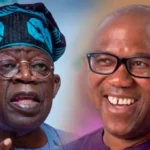
Anambra State Commissioner for Information and Value Reorientation, Law Mefor, has said the administration of Governor Chukwuma Soludo is not interested in indicting former governor Peter Obi over the ongoing controversy surrounding the state’s financial records.
Mefor made the statement during an interview with Rudolf Okonkwo on 90MinutesAfrica, where he addressed the relationship between Soludo and Obi as well as claims concerning loans and funds allegedly left by the former governor.
According to Mefor, there is no personal rift between Soludo and Obi, arguing that both politicians are defending their respective political interests.
“There is no rift between Governor Soludo and Peter Obi. They are both in politics, and they have their interests to defend,” Mefor said.
Mefor Explains Soludo’s Relationship With Tinubu
The commissioner also defended Soludo’s decision to work with President Bola Tinubu, saying it is consistent with the longstanding approach of the All Progressives Grand Alliance (APGA).
Mefor noted that Obi, who served as Anambra governor under APGA, also maintained a working relationship with former President Goodluck Jonathan, who governed Nigeria under the Peoples Democratic Party (PDP).
He therefore argued that Soludo was following a similar approach by maintaining a working relationship with the federal government.
Anambra Debt Controversy: Mefor Says Obi Is Not Being Targeted
Mefor dismissed suggestions that the Anambra government’s scrutiny of Obi’s financial records was designed to discredit his achievements or affect his political ambitions.
The commissioner acknowledged Obi’s performance as governor but said the dispute was specifically about claims concerning the financial obligations inherited by subsequent administrations.
“The intention of the Anambra State government is not to indict Peter Obi. Peter Obi did well as governor,” he said.
The controversy has intensified in recent weeks, with the Anambra government releasing records it says show outstanding loan obligations linked to projects undertaken during Obi’s tenure. The government has cited Debt Management Office (DMO) records in support of its position.
Mefor Challenges Obi’s Ecological Fund Claim
The commissioner also disputed Obi’s claim that his administration left more than ₦2.13 billion in an ecological fund account at First Bank’s UNIZIK branch in Awka.
Mefor said the state government obtained a certified statement from the bank and found no evidence of the claimed balance.
The Anambra government has separately published its version of the account records and challenged Obi to produce documentation supporting his claim.
Commissioner Says Obi-Era Loans Remain Outstanding
Mefor further rejected Obi’s claim that his administration left no loan liabilities for subsequent governments.
According to the commissioner, the Obi administration obtained eight loan facilities and drew down on some of them, leaving repayment obligations for succeeding administrations.
The Anambra government has said the facilities had an original value of about $123.77 million, with approximately $92.35 million outstanding as of June 30, 2026. It has linked the facilities to projects involving areas such as education, healthcare, agriculture, malaria control and erosion management.
Mefor stressed that taking loans was not inherently wrong, particularly where borrowed funds were used for projects capable of benefiting the public.
“Nobody is against a government taking loans. Peter Obi took loans, and we are not saying it’s wrong.”
Obi Disputes the Government’s Interpretation
Obi has disputed the Anambra government’s characterization of the facilities, arguing that several were World Bank and IFAD development programmes negotiated by the Federal Government and accessed by states through subsidiary arrangements.
He has also argued that the facilities should be examined individually, taking into account their approval dates, amounts actually drawn, repayments and outstanding balances, rather than treating the original aggregate value as debt personally incurred by him.
The dispute over Anambra’s financial records therefore remains a matter of competing interpretations of the state’s historical debt obligations and the role played by the various governments involved.